Shigeru Kawai
The scientist who modernized a craft
He joined the company his father founded in 1946. In 1955 — at just thirty-three, following the death of founder Koichi Kawai — he became its second president. Over the thirty-five years that followed, Shigeru Kawai did something quietly radical: he kept the hand at the centre of the piano, and rebuilt almost everything around it with the discipline of science.
One man, two convictions
The story of Shigeru Kawai is best understood as a held tension. He was, at once, the most hands-on of craftsmen and the most far-sighted of modernizers — a maker who insisted a piano must be built by hand, and a leader who spent his presidency bringing science, engineering, and the wider world to bear on how it was built.
Made by hand, on principle
“Pianos are made of wood, so they must be made by hand.”
He had come up from the factory floor, and he never let the workshop out of his sight. To him the hand was not nostalgia but necessity — wood is a living material, and only a trained ear and a practised hand could coax a true voice out of it. That conviction stayed fixed at the centre of everything he changed.
Refined by science
“Combine hand-craftsmanship with the finest technology.”
Around that fixed centre, he changed almost everything else. His guiding aim was to marry the hand to the laboratory — to measure what had only been felt, to test what had only been assumed, and to carry the result out to the world. Under his leadership a regional workshop became a global maker.
He learned the piano by living inside it
Shigeru Kawai joined the family firm in 1946 and gave himself to it completely. As a young worker he would stand on the factory floor for the length of a working day, and there were nights he simply slept in the factory rather than leave the work unfinished. In those early years he and his co-workers even bathed together using a steel drum can for a bathtub — a life lived, quite literally, inside the making of the piano.
That immersion is the key to the man. It is why, decades later and running the whole company, he still trusted the hand and the ear above any instrument on a bench — because he had felt, in his own hands, what a piano is and what it asks of the people who build it.
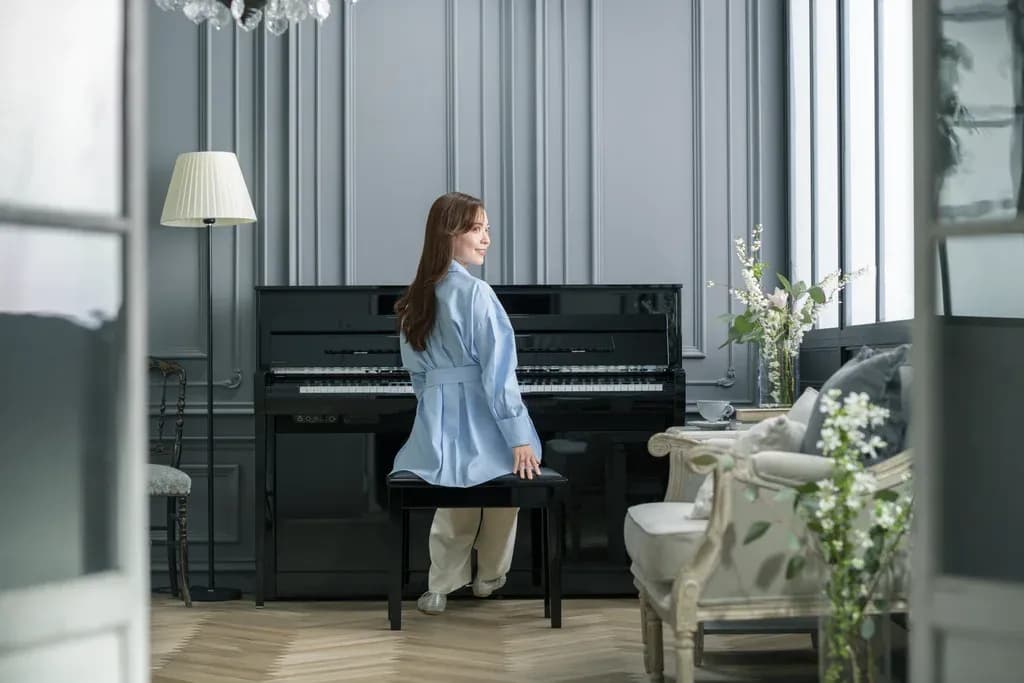
“If you don't like the piano that you build, build it again.”
Bringing the laboratory to the workshop

What Shigeru Kawai added to his father's craft was method. He believed the qualities pianists prize — stability, consistency, evenness of touch — could be studied, measured, and engineered without ever surrendering the hand that finishes the instrument. He set out to combine hand-craftsmanship with the finest technology, and he built the culture that could actually do it.
That culture produced a genuine breakthrough. Beginning in 1968, under his leadership, Kawai's engineers pioneered the use of ABS composite parts in the piano action — components that resist the swelling and shrinking that plague wood in changing humidity, holding their regulation where all-wood actions drift. It was not the work of one man's hands but of a company organised, at last, to innovate — which was precisely his intent.
A regional workshop becomes a global maker
Under Shigeru Kawai the company reached outward — into education, into new materials, and across the world. The dates tell the story of a modernizer at work.
- 1956The Kawai Music School
He founded the Kawai Music School, extending the company from making instruments to teaching the people who would play them.
- 1963Kawai America, Los Angeles
He established Kawai America in Los Angeles — the company's first overseas subsidiary, and the beginning of its life as a global maker.
- 1968ABS composite action parts
Beginning in the late 1960s, Kawai's engineers pioneered ABS composite parts in the piano action under his leadership.
- 1975Kawai Canada
The company established its Canadian presence, continuing the outward expansion across North America.
- 1976–1979Into Germany & Europe
Kawai extended into Germany and the wider European market, carrying the brand to the heart of the classical piano world.
- 1980Ryuyo Grand Piano Factory & Research Laboratory
He opened the Ryuyo facility near Hamamatsu — conceived not merely as a factory but as a research centre for grand-piano making.
- 1981The EX Concert Grand
The EX concert grand was completed — a flagship instrument built to compete on the world stage.
- 1985The concert stage & national honour
Kawai's EX was used at the International Chopin Piano Competition, and Shigeru Kawai received the Blue Ribbon Medal.
A factory built as a laboratory
The Ryuyo Grand Piano Factory, opened in 1980, was the fullest expression of his method. Its very name carries a research laboratory, because that is what he intended: a place where the finest grands could be built by hand and, at the same time, studied and refined — where tone could be measured as well as heard.
It was in this culture that the EX concert grand, completed in 1981, took shape — an instrument built to stand on the world's stages. In 1985 the EX was chosen for the International Chopin Piano Competition, one of the most demanding proving grounds a concert piano can face.
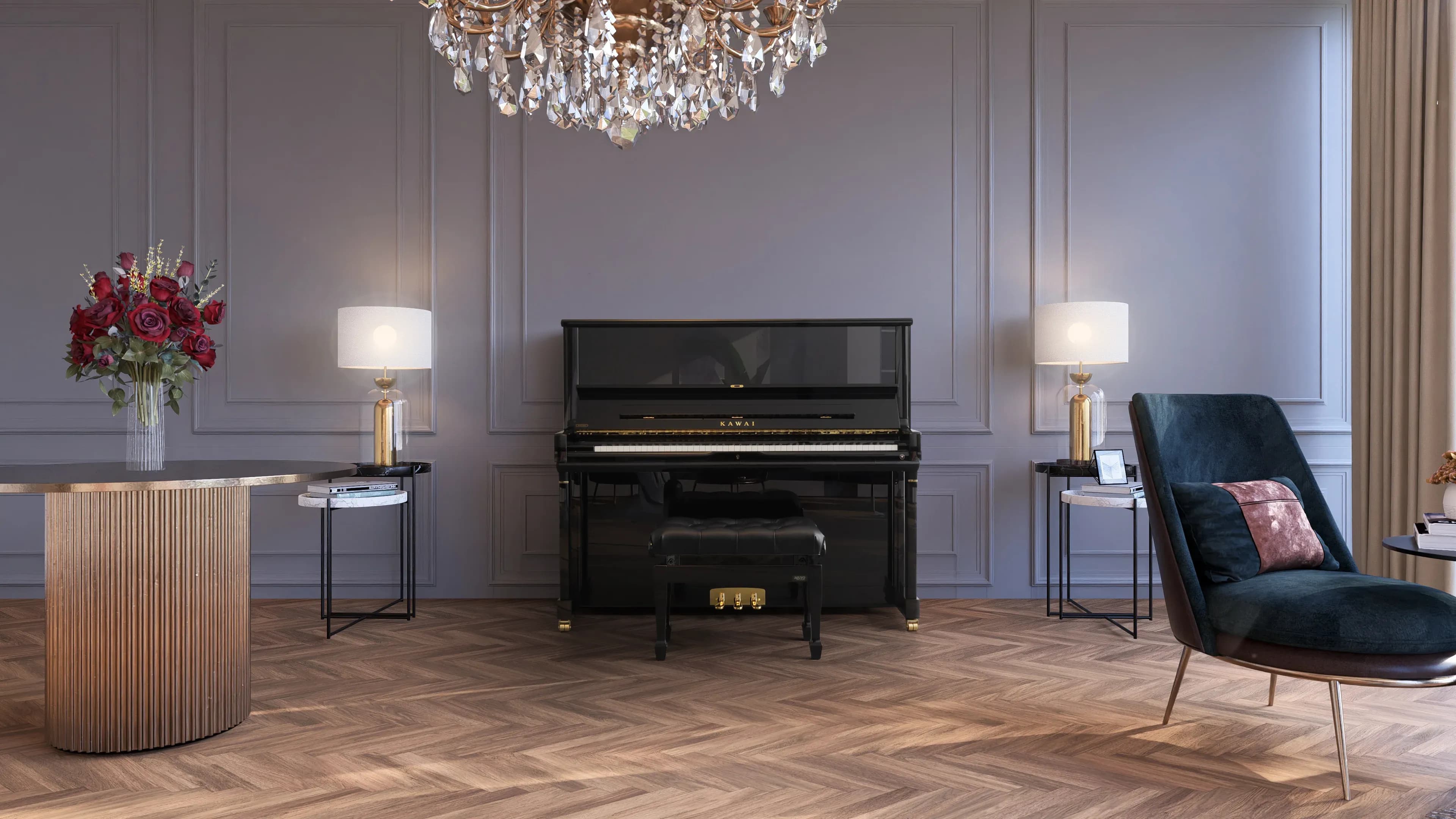
His name on the world’s finest pianos
In 1985 the Japanese government awarded Shigeru Kawai the Blue Ribbon Medal, a national Medal of Honour recognising distinguished contribution. He led Kawai as president until 1989, then served as chairman and later as a consultant to the company until his death in 2006, at the age of eighty-four.
In 1999 — a decade after he stepped down as president — Kawai launched a namesake line of hand-built concert grands, the Shigeru Kawai, in his honour. It was the company's answer to the aspiration that had driven his whole career: to build the world's finest pianos. The instruments carry his name; the method behind them carries his mind.
“Creating pianos is the greatest job I have ever had!”
A craftsman's hands, a scientist's mind
Shigeru Kawai inherited a workshop and left a modern piano maker — without ever letting go of the hand that made the workshop worth inheriting. The paradox was the point, and it is still audible in every Kawai built today.
Sources: Kawai — Company HistoryShigeru Kawai